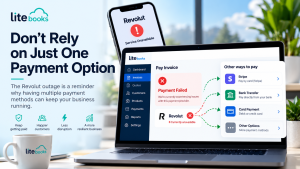

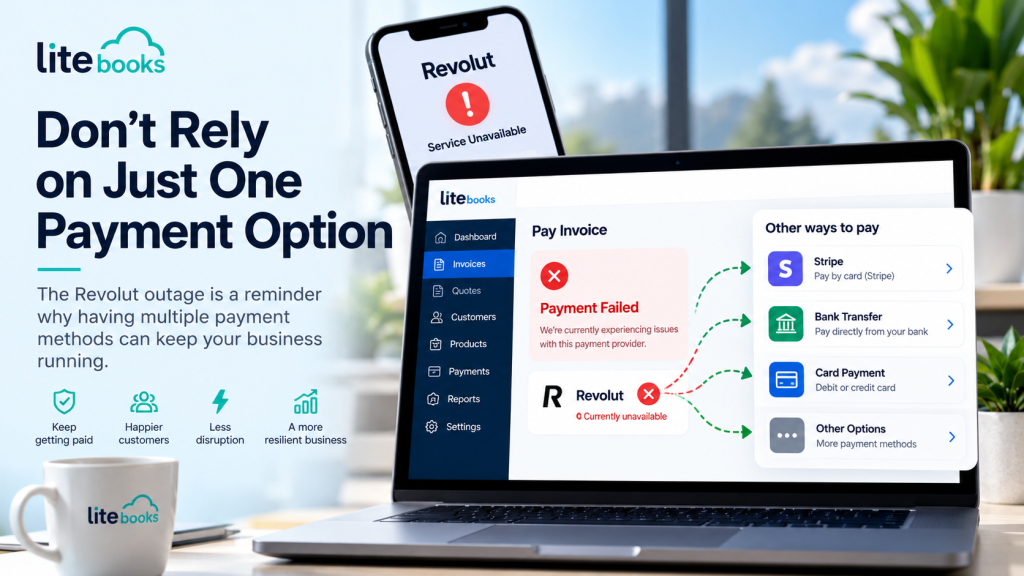
The recent Revolut outage is a reminder that even the biggest payment providers can experience problems. Here’s why having a backup payment option could save your business from lost sales and unnecessary headaches.
Imagine you’ve just finished a job for a customer. You’ve sent them their invoice, they’re ready to pay, and everything is going smoothly.
Then they click the payment link and nothing happens.
They try again. Still nothing.
Or perhaps you’re running a busy shop and customers are standing at the till, but their payments keep getting declined.
Unfortunately, situations like these can happen, and they’re not always within your control.
On 20 October 2026, approx. 3.4 million people experienced payment and banking difficulties when a major Google Cloud outage disrupted services including Revolut.
For small businesses that depend on online payments, it was an important reminder of something that can easily be overlooked:
Having more than one way to accept payments isn’t just convenient. It’s an important part of keeping your business running.
What Happened to Revolut on 20 October 2026?
On Tuesday, 20 October 2026, a power-related incident at Google’s cloud infrastructure in London caused widespread disruption to several online services.
Among those affected was Revolut, one of the increasingly popular banking and payment services used by individuals and businesses across Ireland.
The disruption affected services including card payments, bank transfers, cash withdrawals and access to banking facilities.
Other major financial institutions, including Lloyds and HSBC, also experienced problems.
Google reported that services were recovering during the afternoon, but the incident had already demonstrated just how dependent modern financial services are on technology working behind the scenes.
It’s important to point out that the problem wasn’t necessarily with Revolut’s own banking systems. The disruption was linked to infrastructure provided by another company.
And that’s where things get interesting.
Even if a payment provider has excellent systems, security and reliability, it can still be affected by something going wrong with a third-party service it depends on.
For a small business owner, it doesn’t really matter where the problem started. If your customers can’t pay you, you’ve got a problem.
What Happens When Your Only Payment Option Stops Working?
Let’s say you’re a self-employed electrician, plumber, photographer or contractor.
You’ve completed a job worth €750 and sent your customer an invoice with an online payment option.
Your customer is happy with the work and ready to pay.
But the payment provider is experiencing an outage.
If that’s the only payment method you offer, your customer may have no choice but to wait until the service is working again.
That could mean waiting a few hours, perhaps longer.
And while some customers will come back and pay later, others might forget, get distracted or need another reminder.
For businesses selling products online, the impact could be even more immediate.
A customer who can’t complete a purchase might simply abandon their order.
This can lead to:
- Delayed payments and reduced cash flow.
- Lost sales when customers can’t complete transactions.
- More time spent answering payment-related questions.
- Frustrated customers who don’t understand why their payment isn’t working.
- Additional administration chasing payments after services are restored.
None of these situations is particularly appealing when you’re already busy running a business.
Why Having Multiple Payment Options Makes Sense
The solution isn’t to stop using Revolut, Stripe, PayPal or any other particular payment service.
These are valuable services used by businesses every day.
The lesson is simply not to put all your eggs in one basket.
By offering customers more than one way to pay, you’re giving your business some flexibility when something unexpected happens.
For example, if your preferred payment provider experiences difficulties, you might be able to direct customers towards another provider, a bank transfer or another suitable payment method.
Of course, having multiple providers doesn’t guarantee that you’ll never experience disruption. Different services can sometimes depend on the same underlying technology.
However, choosing genuinely independent backup options can significantly reduce your reliance on a single provider.
Think of it like having a spare key.
You might never need it, but you’ll certainly be glad you have it when something goes wrong.
Different Customers Prefer Different Ways to Pay
There’s another good reason to offer multiple payment options, and it has nothing to do with outages.
Not every customer wants to pay the same way.
Some prefer paying by debit or credit card. Others prefer bank transfers, while some are comfortable using digital payment services.
For businesses that invoice customers, offering more flexibility can make the payment process easier.
Consider a small construction business that works with both homeowners and commercial clients.
A homeowner might prefer to pay a deposit online using a debit card.
A larger company might prefer to pay invoices by bank transfer through its accounts department.
Allowing both customers to use their preferred payment method can make the entire process smoother.
And the easier you make it for customers to pay, the fewer unnecessary obstacles you put between sending an invoice and receiving your money.
How Lite Books Helps Businesses Offer More Payment Options
At Lite Books, we’ve always believed that small businesses should have access to practical tools without unnecessary complications.
That’s why we’ve been working to make invoicing and accepting payments as straightforward and flexible as possible.
Lite Books supports multiple payment integrations, including Revolut and Stripe, allowing businesses to offer online payment options to their customers.
Depending on the payment services you’ve connected and enabled, you can provide customers with different ways to pay their invoices.
For example, rather than relying entirely on one payment service, you can configure additional options where supported.
Customers can then use an available payment method to settle their invoices.
You can also record payments received outside the online payment system, such as bank transfers, helping you keep your invoicing records up to date.
This flexibility can be particularly valuable if one of your payment providers experiences an unexpected problem.
Instead of being completely dependent on a single service, you may have another way for customers to pay.
And because Lite Books also supports recording partial payments and issuing payment receipts, you can keep track of money received even when customers pay using different methods.
Our goal is simple: make it easier for Irish businesses to send invoices, accept payments and keep accurate records, without making things more complicated than they need to be.
Five Things Every Small Business Can Do to Prepare for Payment Outages
You don’t need to be a technology expert to protect your business from some of the problems caused by payment service outages.
A little preparation can make a big difference.
1. Set Up a Second Payment Provider
If your business relies heavily on one online payment service, consider setting up another one as a backup.
Ideally, make sure it can operate independently of your main provider.
It’s much easier to arrange this in advance than to start registering for another payment service when your existing one stops working.
2. Keep Bank Transfer Details Available
Online payment links are convenient, but traditional bank transfers can still be useful.
Make sure customers have access to the correct bank account details when appropriate.
Remember that banks and bank transfer networks can also experience outages, so this shouldn’t be your only backup.
3. Make Sure Customers Can Contact You
If customers are experiencing problems paying an invoice, make it easy for them to get in touch.
Sometimes a quick email or phone call is all that’s needed to arrange an alternative payment method.
4. Keep Your Invoicing Records Accurate
If a customer pays you outside your normal online payment system, make sure you record that payment against the correct invoice.
This helps prevent confusion, duplicate payment requests and unnecessary reminders.
Accounting software like Lite Books can help you keep those records organised.
5. Have a Simple Backup Plan
You don’t need a complicated business continuity document.
Just ask yourself:
If my main payment provider stopped working tomorrow, how would my customers pay me?
If you don’t have a clear answer, it’s probably time to put a backup option in place.
What Should You Do When a Payment Provider Goes Down?
First of all, don’t panic.
Payment outages can be frustrating, but they don’t automatically mean that your money is lost or your accounts have been compromised.
Check the payment provider’s official service updates to understand what’s happening.
If the outage affects customer payments, consider temporarily offering an alternative payment method.
For invoices that haven’t yet been paid, you could contact customers and explain the situation.
For example:
“We’re currently experiencing some disruption with one of our online payment providers. If you’re having difficulty paying your invoice, please contact us and we’ll arrange an alternative payment method. Sorry for any inconvenience.”
It’s also important to check whether a payment has already been processed before asking a customer to try again using another method.
You don’t want to accidentally charge somebody twice.
Once everything is working again, review any outstanding payments and update your records accordingly.
The Real Lesson from the Revolut Outage
The outage on 20 October 2026 wasn’t simply a Revolut problem.
It highlighted something much bigger about how modern businesses operate.
We increasingly rely on digital services to manage our finances, communicate with customers, accept payments and run our day-to-day operations.
Most of the time, these systems work so well that we barely give them a second thought.
But when something goes wrong, we quickly realise just how dependent we’ve become on them.
The answer isn’t to avoid technology.
It’s to use it sensibly, with a little preparation for the unexpected.
For small businesses, offering more than one payment method is a relatively simple step that can make a real difference.
Because when one payment option stops working, your business shouldn’t have to stop with it.
Make Invoicing and Payments Easier with Lite Books
Lite Books is designed specifically for Irish sole traders and small businesses.
Whether you’re a tradesperson, freelancer, contractor or running a growing business, Lite Books gives you practical tools to manage your invoices, customers, payments and bookkeeping in one place.
With features such as online payment integrations, partial payments, automatic receipts, invoice reminders and customer statements, we’re working to make everyday business administration easier.
And with a 30-day free trial, you can explore everything Lite Books has to offer before deciding if it’s right for you.
Try Lite Books Free for 30 Days
Lite Books is Irish invoicing and bookkeeping software, built with small businesses in mind.
FAQ’s
Should a small business use more than one payment provider?
Yes. Having more than one provider can give customers alternative ways to pay if your preferred service experiences problems. Ideally, your backup should not depend on exactly the same systems as your primary provider.
What happens if Revolut goes down while a customer is paying an invoice?
The transaction may fail, remain pending or be delayed. Check the payment status before requesting another payment to avoid accidentally charging the customer twice.
Can Irish businesses accept payments through different providers?
Yes. Irish businesses can use multiple payment providers, subject to each provider’s terms, eligibility requirements and fees. They can also offer bank transfers and other suitable payment methods.